A report on one case from Madhya Pradesh, and what it shows about how these laws work
Picture a small village home. A couple has invited friends and relatives to celebrate their daughter’s fifth birthday. There is cake, there are children, and a few guests are pastors from nearby villages. By the end of the day, seven of those guests are in police custody. Two years later, a court sentences each one to five years in prison for “forced conversion.”
This is not a hypothetical story. It is what the reports describe, and it shows better than any statistic how anti-conversion laws operate on the ground.
What happened in Dindori
A Christian couple invited a small number of friends and relatives to their home in a Madhya Pradesh village on 27 April 2024 to celebrate their daughter’s fifth birthday. The party was disrupted when a mob of 100 to 150 extremists surrounded the house, barring the guests inside and shouting threats and slogans. One guest called the police, who calmed the crowd but arrested only the seven Christians. When questioned, the child’s parents told police the gathering was purely a social occasion. (Barnabas Aid; Church in Chains)
According to Christian advocacy groups, the father called the police for protection, but officers arrested the seven after a neighbor accused them of offering money to induce conversions. (Worthy News)
The case dragged on for more than two years. Then, in a judgement delivered on 12 June 2026, each pastor was given the maximum prison term of five years, and each was also fined 100,000 rupees, more than $1,000, with their sentence being “rigorous,” which adds hard labor. (Barnabas Aid; International Christian Concern)
The men were Amit Kumar, Chhot Singh Dhurve, Jeet Singh Dhurve, Karan Singh Maravi, Pramod, Sanjay Markam and Santosh Paraste. The youngest was twenty years old.
The other side of the story
Fairness requires saying what the other side says. A Hindu-nationalist news outlet reported the verdict as a conviction for a conversion gathering, and said that the court convicted all seven under Sections 3 and 5 of the Madhya Pradesh Freedom of Religion Act. Another report adds that they were also convicted under India’s penal code of promoting enmity between religious groups and acts intended to outrage religious feelings. The court believed the prosecution’s version of events, and the accused and their families maintain it was a birthday party. (Organiser; The Alabama Baptist)
I cannot see the evidence the court saw, and the convicted men have appealed. What I can do is point out what the surrounding facts suggest, and let readers judge.
Why the law makes cases like this possible
Madhya Pradesh’s law, the Freedom of Religion Act of 2021, bans conversion by misrepresentation, allurement, threat, force, undue influence, coercion, marriage or any fraudulent means. Three features stand out.
- The burden of proof is on the accused. Section 12 says the burden of proving that a conversion was not obtained through force, allurement or fraud lies on the accused. In most legal systems, the prosecution must prove guilt. Here, the person charged must prove his innocence, which is far harder when the charge is about what was in other people’s hearts. (Scroll.in)
- “Allurement” is a wide net. The law does not define ordinary kindness, such as a meal, a gift, a school fee or help with a medical bill, as outside the offense. Critics say that in practice, charity and invitation can both be called “inducement.” A Wall Street Journal op-ed noted that “allurement” is often defined as any form of evangelical persuasion. (AEI)
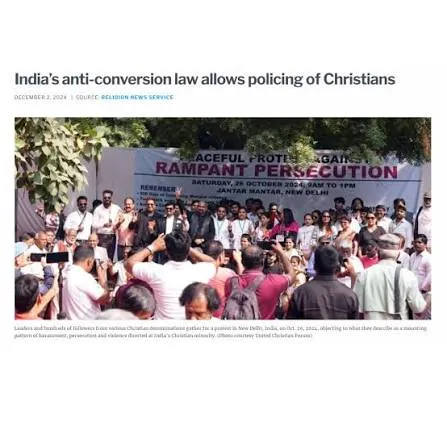
- The law says who may complain, but mobs do it anyway. The Act allows the converted person or their parents or siblings to file a complaint, and other relatives only with the permission of the court. That is a meaningful safeguard on paper. Yet in this case, reports say a neighboring villager disrupted the party and accused the guests of luring local people to convert. How the case was formally registered is a question the appeal may well examine. What is clear is that a crowd gathered, an accusation was made, and the Christians were the ones arrested. The Madhya Pradesh High Court has itself held that police have no jurisdiction to investigate such an offense without a written complaint from the aggrieved person. (Sabrang India)
The Madhya Pradesh government is led by the BJP, as the International Society for Human Rights notes, having governed the state since March 2020. I do not claim that the party ordered this prosecution. The point is that the law was written and is enforced by that government, and the result is what we see. (International Society for Human Rights)
The cost to families and churches
The sentence did not only fall on seven men. The pastors served congregations in six villages, which have now been forced to shut down, leaving believers without spiritual leadership. The men were the primary breadwinners for their wives and children, who are now in a precarious financial position. (International Christian Concern)
Reports say theirs was only the second case of Christians being convicted under Madhya Pradesh’s anti-conversion law. If that is so, this is not just one unlucky case, but a precedent. (The Alabama Baptist)
A small light
There is some good news. The seven pastors were granted bail on 18 August, when the High Court in Jabalpur heard that none had a previous criminal record, and granted them leave to appeal. They must return to court on 7 January 2027. (Barnabas Aid; Church in Chains)
And something else happened in prison that is worth telling. A ministry report says the first days were difficult, but Pastor Jeet kept encouraging the others to remain strong in their faith and trust God, and said the peace they were witnessing came from Jesus Christ. (Church in Chains)
That sounds like Paul and Silas in Philippi, who after being beaten and locked in the inner prison were found “praying, and sang praises unto God: and the prisoners heard them” (Acts 16:25). The jailer came to faith that night.
What the Bible says about this
The Bible does not promise that Christians will be spared. It promises that God will be with them.
“Blessed are they which are persecuted for righteousness’ sake: for theirs is the kingdom of heaven.” (Matthew 5:10)
“Remember them that are in bonds, as bound with them; and them which suffer adversity, as being yourselves also in the body.” (Hebrews 13:3)
“Open thy mouth for the dumb in the cause of all such as are appointed to destruction. Open thy mouth, judge righteously, and plead the cause of the poor and needy.” (Proverbs 31:8-9)
Scripture also tells us that those who make unjust laws will answer for them:
“Woe unto them that decree unrighteous decrees, and that write grievousness which they have prescribed; To turn aside the needy from judgment, and to take away the right from the poor of my people.” (Isaiah 10:1-2)
And it tells us how to respond to those who do it:
“Bless them which persecute you: bless, and curse not.” (Romans 12:14)
“Father, forgive them; for they know not what they do.” (Luke 23:34)
Why even non-Christians should care
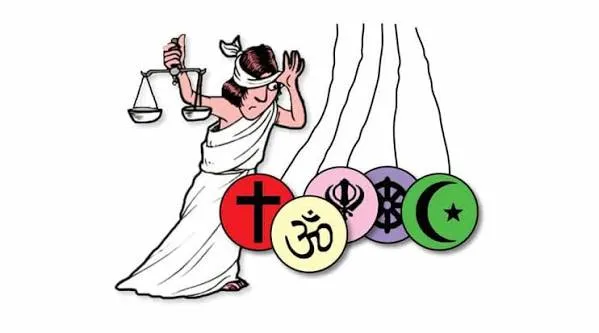
You do not have to be a Christian to see the problem. A law that makes the accused prove their innocence, that treats a gift or a kind act as a crime, and that lets a crowd decide who gets arrested can be turned against anyone: a Muslim, a Sikh, a Hindu who changes his mind, or a family that simply celebrates a birthday. The right to choose and to speak about one’s faith is protected by India’s own constitution (Article 25) and by international law. Defending it for Christians defends it for everyone.
And the question the law claims to answer is already covered by existing criminal law. Force, fraud and coercion are crimes in any country, and no one is asking for them to be allowed. What is being asked is that the state prove its case, and that a birthday party not be treated as a crime scene.
What you can do
- Pray for the seven men, their wives and children, the six villages whose churches are closed, and the appeal on 7 January 2027.
- Support organizations that provide legal help to persecuted believers in India, such as the Evangelical Fellowship of India and the United Christian Forum.
- Share accurate information. Facts, names and court dates are more persuasive than anger.
- Pray for those who accuse, including the neighbors and the officials. They need the gospel too.
An invitation
The seven men in Dindori were not arrested for hurting anyone. They were arrested, according to their families, for gathering at a child’s birthday, and whatever one believes about that, they are still sitting in the shadow of a sentence for following Jesus. Their peace in that shadow is the real message of this story.
“For God so loved the world, that he gave his only begotten Son, that whosoever believeth in him should not perish, but have everlasting life.” (John 3:16)
If you want to know the Christ these men would not deny, you can come to Him now:
“That if thou shalt confess with thy mouth the Lord Jesus, and shalt believe in thine heart that God hath raised him from the dead, thou shalt be saved.” (Romans 10:9)
You can pray something like this:
“Lord Jesus, I admit that I have sinned and cannot save myself. I believe You died for me and rose again. Forgive me, come into my life and be my Lord and Savior. Amen.”
If you prayed that, tell a Christian friend, find a Bible-believing church and begin reading the Gospel of John.
They can arrest the pastors and close the churches, but they cannot silence the peace of Christ.
Glory to Jesus Christ, who is with His people in every prison.
Sources
- Seven Indian pastors convicted under anti-conversion law after child’s birthday party arrests, Barnabas Aid, June 18, 2026
- Christians Sentenced to Prison for ‘Forced Conversions’ at Birthday Party, International Christian Concern, Aug 3, 2026
- Joy as seven pastors freed from jail in India, Barnabas Aid
- INDIA: Seven pastors released on bail, Church in Chains
- Seven falsely accused Christians sentenced to prison, The Alabama Baptist, Aug 13, 2026 (citing Morning Star News)
- Seven Indian Christians Sentenced To Five Years After Birthday Gathering, Worthy News
- India: Five years in prison following false conversion allegations, International Society for Human Rights
- 6 Pastors sentenced to 5 years, Organiser (the prosecution’s account)
- The Madhya Pradesh Freedom of Religion Act, 2021: Scroll.in report on the notified law
- MP govt notifies Freedom of Religion Act, 2021, Sabrang India
- The Hindu Attacks on India’s Christians, Wall Street Journal op-ed (via AEI)
- The Leaflet, on the Madhya Pradesh High Court’s ruling about written complaints