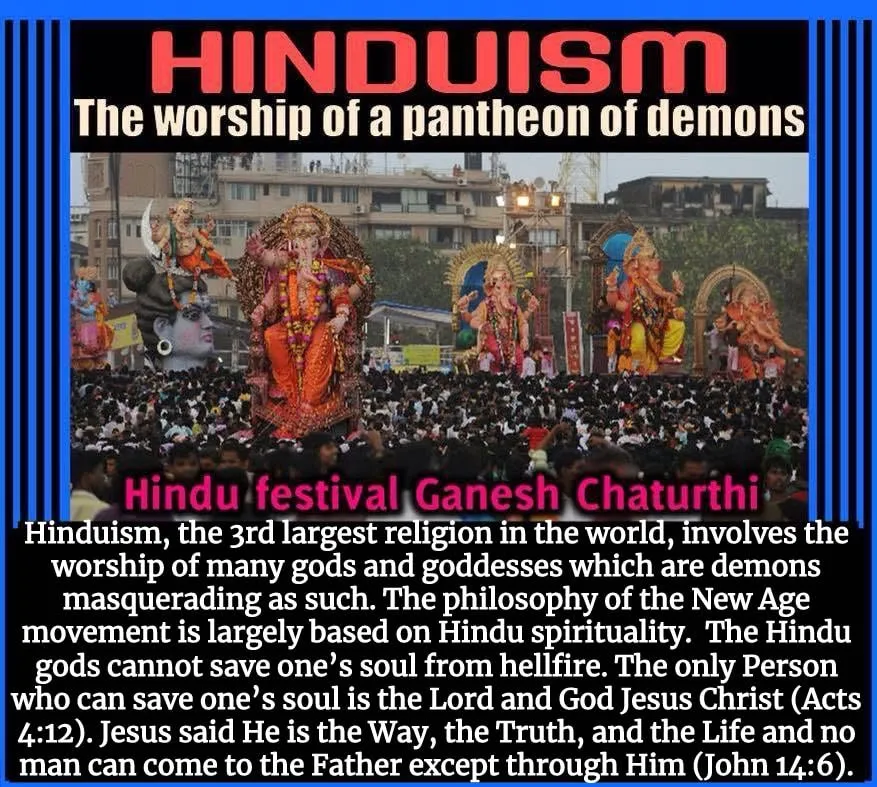
Hinduism is the third largest religion in the world, with about a billion followers. Every year, festivals like Ganesh Chaturthi draw enormous crowds into the streets with beautiful, towering images of gods. I grew up around this, and I know how sincere, warm and devoted many Hindu families are. I’m not writing against people. I’m writing because the Bible makes a serious claim about what stands behind idol worship, and anyone who loves Hindu friends and family should say it plainly and gently.
What the Bible says about the gods of the nations
The Bible does not treat idols as harmless symbols. It says there is something behind them.
“They sacrificed unto devils, not to God; to gods whom they knew not, to new gods that came newly up, whom your fathers feared not.” (Deuteronomy 32:17)
“They… sacrificed their sons and their daughters unto devils.” (Psalm 106:36-37)
The New Testament repeats the same teaching:
“But I say, that the things which the Gentiles sacrifice, they sacrifice to devils, and not to God: and I would not that ye should have fellowship with devils.” (1 Corinthians 10:20)
Paul says an idol itself is nothing (1 Corinthians 10:19), but the worship offered to it is not neutral. According to Scripture, the worshiper is not reaching God. Spiritual powers opposed to God are receiving the honor that belongs to Him alone.
Deception wearing a beautiful face
An image of a god covered in flowers, gold and light does not look like anything dark, and that is the point. The Bible warns that deception does not come looking ugly:
“Satan himself is transformed into an angel of light.” (2 Corinthians 11:14)
“The god of this world hath blinded the minds of them which believe not, lest the light of the glorious gospel of Christ… should shine unto them.” (2 Corinthians 4:4)
Spiritual deception rarely announces itself. It presents itself as wisdom, tradition, peace or beauty. That is why the Bible tells us to test what we are following:
“Beloved, believe not every spirit, but try the spirits whether they are of God.” (1 John 4:1)
The test of the gods
If we ask whether these gods could be the true God, Scripture gives us a measure to apply.
They quarrel and sin. The stories of the Puranas show gods who curse, scheme, fight and fall, which is not the character of a holy God. The Lord says, “Be ye holy; for I am holy.” (1 Peter 1:16)
There are many of them. The Bible says there is one God, not millions. “Hear, O Israel: The LORD our God is one LORD.” (Deuteronomy 6:4) and “I am the LORD, and there is none else, there is no God beside me.” (Isaiah 45:5)
They cannot save. “Neither is there salvation in any other: for there is none other name under heaven given among men, whereby we must be saved.” (Acts 4:12)
The New Age connection
Much of what the West calls “spirituality” today, including yoga as a spiritual path, kundalini, chakra work, guided meditation and the idea that “all paths lead to the same God,” draws heavily on Hindu thought. These ideas are packaged as wellness and self-improvement, and millions of people take them up without realizing they are embracing a religious system. From a Christian point of view, this is the same pattern again: a gentle, attractive path that leads away from Christ, who said “I am the way, the truth, and the life: no man cometh unto the Father, but by me.” (John 14:6)
The Bible warns that this will happen:
“Now the Spirit speaketh expressly, that in the latter times some shall depart from the faith, giving heed to seducing spirits, and doctrines of devils.” (1 Timothy 4:1)
Why this matters
We say this for one reason: the stakes are eternal, and the people involved are loved. Jesus did not come to condemn the world but to save it (John 3:17). The Bible does not say Hindus are worse than anyone else. It says all of us, Western or Eastern, have sinned (Romans 3:23) and that every one of us needs a Savior.
What Christ does for those who come out
The good news is that no one is trapped. Jesus’ ministry was full of people set free from spiritual bondage. Paul described what happened to those who turned from idols:
“For they themselves shew of us what manner of entering in we had unto you, and how ye turned to God from idols to serve the living and true God.” (1 Thessalonians 1:9)
“Who hath delivered us from the power of darkness, and hath translated us into the kingdom of his dear Son.” (Colossians 1:13)
At the cross, Christ “spoiled principalities and powers, he made a shew of them openly, triumphing over them in it.” (Colossians 2:15) No spiritual power is greater than Jesus Christ, and He offers freedom, forgiveness and peace to anyone who calls on Him.
“For whosoever shall call upon the name of the Lord shall be saved.” (Romans 10:13)
If you are reading this from inside Hinduism, I’m not asking you to hate your family or your heritage. I’m asking you to consider whether Jesus is who He said He is. He did not come as one god among many. He came as the Lord of all, and He is able to save.
All glory to Jesus Christ, the only true and living God.