
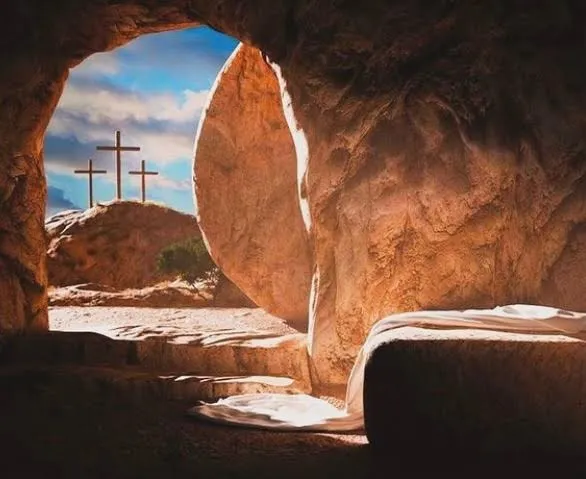
Every religion tells you something about God. Only one stakes everything on an event that could have been disproved in a single afternoon: a tomb that was found empty.
If Jesus stayed dead, Christianity falls. The apostle Paul said so himself:
“And if Christ be not risen, then is our preaching vain, and your faith is also vain.” (1 Corinthians 15:14)
Few religious leaders would put it so plainly. So let’s look at what the evidence says, and compare it with what other faiths offer.
The tomb is where other founders differ
Think about the founders of the world’s major religions.
- Buddha died around the 5th century BC, and tradition says his body was cremated and the relics were divided among followers. His followers do not claim he rose.
- Muhammad died in 632 AD and is buried in Medina, where his tomb is visited by pilgrims to this day. No Muslim claims that he rose.
- Confucius is buried in Qufu, China.
- Hindu deities are different, since they belong to stories and traditions that are not tied to a datable place or an examinable grave, so there is no tomb to inspect either way.
None of this is an insult to anyone. It simply shows that Jesus’ claim is unusual, because it is a claim about a specific event, in a specific city, in a specific week, which anyone in Jerusalem could have checked. The Christian message did not begin in a distant land or a distant century. It began in Jerusalem, within weeks of the crucifixion, among people who could walk to the tomb.
What historians agree on
Even many scholars who don’t share Christian faith accept several facts about the first Easter:
- Jesus was crucified under Pontius Pilate. This is recorded not only in the Gospels but by the Roman historian Tacitus, who writes that Christ was executed under Pilate during the reign of Tiberius.
- His followers were convinced that He rose and appeared to them. The conviction is not in dispute, only what caused it.
- A skeptic became a believer: James. Jesus’ own brother did not believe in Him during His ministry (John 7:5), yet he became a leader of the Jerusalem church.
- An enemy became an apostle: Paul. He was persecuting Christians when he said he met the risen Christ.
Any explanation of Easter has to account for all of these.
The empty tomb
All four Gospels say that the tomb was found empty on the first day of the week.
“He is not here: for he is risen, as he said. Come, see the place where the Lord lay.” (Matthew 28:6)
A detail often overlooked is that the first witnesses were women. In the first-century Jewish world, a woman’s testimony carried little weight in court. If the story had been invented, it would have made the first witnesses respected men. The Gospels name Mary Magdalene and the other women because that is who was there.
The opponents of Jesus never produced a body. Instead, Matthew records that the authorities told a different story:
“His disciples came by night, and stole him away while we slept.” (Matthew 28:13)
That explanation admits the tomb was empty. The argument was over why, not whether. And a group of sleeping guards cannot testify to what happened while they slept.
An early record, not a late legend
Skeptics sometimes say the resurrection was a legend that grew over centuries. But the evidence shows the opposite. In his first letter to the Corinthians, written about twenty years after the crucifixion, Paul passes on a summary of the faith that he received, which scholars date to within a few years of the event:
“For I delivered unto you first of all that which I also received, how that Christ died for our sins according to the scriptures; And that he was buried, and that he rose again the third day according to the scriptures: And that he was seen of Cephas, then of the twelve: After that, he was seen of above five hundred brethren at once; of whom the greater part remain unto this present, but some are fallen asleep.” (1 Corinthians 15:3-6)
Notice the challenge. Paul says that most of the five hundred witnesses were still alive when he wrote. In effect he is saying: go and ask them. A legend does not invite cross-examination.
The disciples were transformed
The Gospels do not paint the disciples as heroes. When Jesus was arrested, they ran away, and Peter denied Him three times. They hid behind locked doors (John 20:19).
Then something changed. Within weeks, these same men were preaching in Jerusalem, the very city where Jesus had been executed, accusing the authorities and refusing to be silent.
“We ought to obey God rather than men.” (Acts 5:29)
They were beaten, jailed and threatened, and some of them were killed. Acts records the execution of Stephen (Acts 7) and of James, the brother of John (Acts 12:2). People do die for beliefs that are false, but they do not do so when they know they made it up. The disciples were not defending a tradition they inherited. They claimed to have seen Him, and nothing they could gain explained their willingness to suffer for it.
“But dead men don’t rise”
That is true, and everyone in the first century knew it. That is exactly why the disciples were so shocked, and why Thomas refused to believe without seeing for himself:
“Except I shall see in his hands the print of the nails, and put my finger into the print of the nails, and thrust my hand into his side, I will not believe.” (John 20:25)
A week later, Jesus appeared and invited him to look:
“Reach hither thy finger, and behold my hands; and reach hither thy hand, and thrust it into my side: and be not faithless, but believing. And Thomas answered and said unto him, My Lord and my God.” (John 20:27-28)
The Christian claim is not that resurrections are normal. It is that this was a one-time act of God, which is exactly what we’d expect if Jesus is who He said He was.
“To whom also he shewed himself alive after his passion by many infallible proofs, being seen of them forty days.” (Acts 1:3)
Honest questions
Here is the fair way to put it. The resurrection is a historical claim that every reader has to weigh. Skeptics offer alternatives: that the disciples hallucinated, that the body was moved, or that the story grew over time. Christians believe these explanations fail to account for all the evidence together: the empty tomb, the multiple appearances to groups and individuals, the conversion of James and Paul, and the speed and boldness of the first preaching. Reading the sources for yourself and weighing it honestly is something I would encourage anyone to do.
Why it matters for you
The resurrection is not only about what happened to Jesus. It is the proof that what He said is true.
“Declared to be the Son of God with power, according to the spirit of holiness, by the resurrection from the dead.” (Romans 1:4)
It means the debt of our sin was paid and accepted. It means death does not have the last word:
“O death, where is thy sting? O grave, where is thy victory?” (1 Corinthians 15:55)
And it means we have a living Lord, not a memory:
“I am he that liveth, and was dead; and, behold, I am alive for evermore, Amen; and have the keys of hell and of death.” (Revelation 1:18)
Every other founder can be visited at a grave. Jesus can be met, because He is alive.
An invitation
You do not have to take my word for it. Read the Gospel of John for yourself, ask honest questions, and ask God to show you the truth. He promises to answer:
“And ye shall seek me, and find me, when ye shall search for me with all your heart.” (Jeremiah 29:13)
If you believe, you can come to Him now:
“That if thou shalt confess with thy mouth the Lord Jesus, and shalt believe in thine heart that God hath raised him from the dead, thou shalt be saved.” (Romans 10:9)
You can pray something like this:
“Lord Jesus, I believe You died for my sins and rose again on the third day. I admit that I have sinned and cannot save myself. Forgive me, come into my life and be my Lord and Savior. Amen.”
If you prayed that, tell a Christian friend, find a Bible-believing church and begin reading the Gospel of John.
Other founders have tombs that are occupied. Jesus’ tomb is empty, and He is alive.
Glory to Jesus Christ, the risen Lord.