Most of us have heard of David and Goliath, but few have heard the story of the idol that fell down twice before the Lord. It is short, a little strange and easy to overlook. It is also one of the clearest pictures in the Bible of what happens when a made-up god stands next to the living God.
How the ark ended up in an idol’s temple
The story starts with a defeat. Israel was at war with the Philistines and had just lost a battle. The elders decided the solution was to bring the ark of the covenant, the sacred chest that represented God’s presence, into the camp:
“Let us fetch the ark of the covenant of the LORD out of Shiloh unto us, that, when it cometh among us, it may save us out of the hand of our enemies.” (1 Samuel 4:3)
Notice what they were doing. They were treating the ark like a lucky charm and God like a tool they could use. The result was worse than before. Israel was defeated, thirty thousand soldiers fell, and the Philistines captured the ark of God (1 Samuel 4:10-11).
It looked as though the Philistine god had won. The Philistines carried the ark in triumph to the city of Ashdod and placed it in the temple of Dagon, one of their chief gods, setting it next to his statue (1 Samuel 5:1-2). In their minds, they were putting the trophy of a defeated God at the feet of the victor.
The first morning
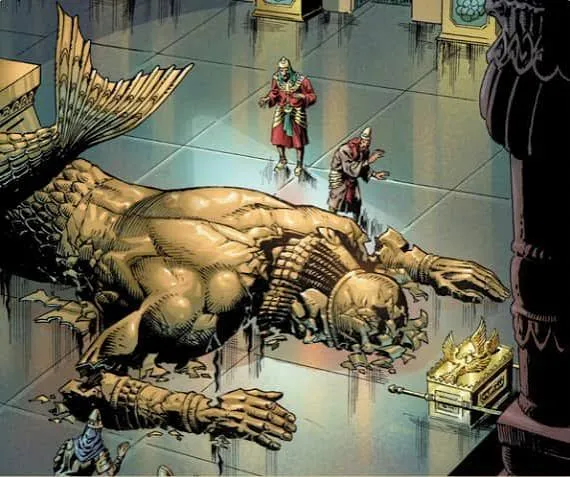
“And when they of Ashdod arose early on the morrow, behold, Dagon was fallen upon his face to the earth before the ark of the LORD. And they took Dagon, and set him in his place again.” (1 Samuel 5:3)
Think about the scene. Priests walk into the temple at dawn and find their god lying face-down on the floor, in the posture of someone bowing to a superior. They had to pick him up and stand him on his feet again.
Look at that detail. A god who has to be lifted back onto his pedestal is a god who cannot stand on his own.
The second morning
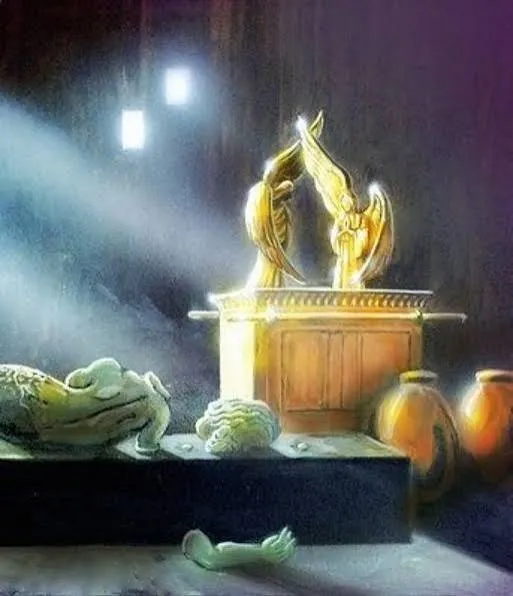
“And when they arose early on the morrow morning, behold, Dagon was fallen upon his face to the ground before the ark of the LORD; and the head of Dagon and both the palms of his hands were cut off upon the threshold; only the stump of Dagon was left to him.” (1 Samuel 5:4)
This time it was worse. The head and hands, the parts that stand for thought and power, were cut off and lying on the threshold. Only the torso remained.
The Bible adds a small detail: because of this, the priests of Dagon “tread not on the threshold of Dagon in Ashdod unto this day” (1 Samuel 5:5). The place where their god’s head and hands lay became a place they would not step.
What the story is saying
Pause to think about what has happened here. The ark of God was in enemy hands. Israel had lost. No Israelite soldier was there. No priest of Israel was present. And God did not need any of them. He defended His own name, alone, in the temple of His rival, without a word or a sword.
Four things stand out:
- God does not need our help. Israel thought they had to carry God into battle. The story shows that He was never in danger. When He is mocked, He answers for Himself.
- God is not a lucky charm. Israel’s mistake was to treat the ark as a tool they controlled. God is not a symbol or an object to use. He is the living Lord, and He will not be used, even by His own people.
- An idol cannot defend itself. Dagon could not stand up, could not keep his head, and could not protect his own temple. The priests could not stop what happened. A god who needs protection from his worshippers is not much of a god.
- The idol’s fall was an act of worship, whether it wanted to be or not. Dagon fell on his face, the position of bowing, before the ark. The false god was forced to bow before the true one.
The Philistines understood the message
What happened afterwards is just as interesting. The people of Ashdod were struck with tumors, and the Philistines drew the right conclusion:
“The ark of the God of Israel shall not abide with us: for his hand is sore upon us, and upon Dagon our god.” (1 Samuel 5:7)
They moved the ark to Gath, and then Ekron, and the same thing followed. The people of Ekron cried out, “They have brought about the ark of the God of Israel to us, to slay us and our people.” (1 Samuel 5:10)
After seven months, the Philistine leaders called their priests and diviners and asked what they should do. They were told to send the ark back with an offering, and to give glory to the God of Israel:
“Wherefore then do ye harden your hearts, as the Egyptians and Pharaoh hardened their hearts? when he had wrought wonderfully among them, did they not let the people go?” (1 Samuel 6:6)
Look at that. Their own priests warned them that this is what happened to Pharaoh when he resisted the God of Israel. Even pagan priests recognized that this God was different from the gods they knew.
The same message across the Bible
This story is not an isolated event. It is the same truth the Bible keeps repeating.
“Their idols are silver and gold, the work of men’s hands. They have mouths, but they speak not: eyes have they, but they see not.” (Psalm 115:4-5)
“Bel boweth down, Nebo stoopeth, their idols were upon the beasts, and upon the cattle: your carriages were heavy loaden; they are a burden to the weary beast. They stoop, they bow down together; they could not deliver the burden, but themselves are gone into captivity.” (Isaiah 46:1-2)
Dagon is not an exception. When the living God stands next to an idol, the idol cannot stand.
What this means for us today
Not many of us have a statue of Dagon in our home, but this story speaks to everyone.
- To someone who worships idols: You are being asked to honor something that has to be carried, cleaned, repaired and guarded. It cannot rise by itself, speak or answer. The God of the Bible stands on His own, and nothing can bring Him down.
- To someone who feels Christianity has lost: Israel lost the battle and lost the ark, and it looked as though their God had been defeated. It was only an appearance. God was never defeated, and He has never needed us to win for Him. Even when the church is attacked, persecuted or pushed down, He is not in danger.
- To a believer treating God like a lucky charm: Don’t. He is not a tool to be used for our plans. He is the Lord, to be worshipped.
The One who does not fall
The story of Dagon ends with an idol broken on a threshold. But the Bible’s story of the true God has a very different ending. The Lord Jesus was nailed to a cross and buried in a tomb, and it looked as though He was defeated. But on the third day He rose, and He will never fall again.
“Wherefore God also hath highly exalted him, and given him a name which is above every name: That at the name of Jesus every knee should bow, of things in heaven, and things in earth, and things under the earth; And that every tongue should confess that Jesus Christ is Lord, to the glory of God the Father.” (Philippians 2:9-11)
Every knee will bow, and the only question is whether we bow now, freely, or later. Dagon was forced to his face. We can come willingly.
“I am the LORD: that is my name: and my glory will I not give to another, neither my praise to graven images.” (Isaiah 42:8)
An invitation
If you have been trusting in a god that cannot stand on its own, I invite you to turn to the one who can. You don’t need a ritual or a priest. You can come now.
“Ye turned to God from idols to serve the living and true God.” (1 Thessalonians 1:9)
“That if thou shalt confess with thy mouth the Lord Jesus, and shalt believe in thine heart that God hath raised him from the dead, thou shalt be saved.” (Romans 10:9)
You can pray something like this:
“Lord Jesus, I turn away from every false god and from trusting in anything made by human hands. I admit that I have sinned and cannot save myself. I believe You died for me and rose again. Forgive me, come into my life and be my Lord and Savior. Amen.”
If you prayed that, tell a Christian friend, find a Bible-believing church and begin reading the Gospel of John.
Dagon fell on his face before the ark. Every false god will fall before Jesus Christ.
Glory to Jesus Christ, the one true and living God.