“Which religion is the oldest?” is a question that comes up again and again, and most of the time it is argued with manuscripts and archaeology. But there is another way to ask it: what does each tradition say about how worship began?
The Bible gives a clear and specific answer. It says the first human beings did not begin with many gods. They began with one Creator, and idol worship came afterward as a departure from Him. Whether or not you accept this account, it is worth understanding what it says, because it changes the question from “which is oldest?” to “which is true?”
In the beginning: one God, one family
The Bible opens with a single sentence:
“In the beginning God created the heaven and the earth.” (Genesis 1:1)
There is one God before anything else, and He made everything, including the sun, moon, stars and animals that other cultures came to worship. The first humans were not made from many gods or by many gods. They were made by one:
“So God created man in his own image, in the image of God created he him; male and female created he them.” (Genesis 1:27)
In Genesis, Adam and Eve walked and talked with God Himself (Genesis 3:8). There were no temples, no images and no intermediaries. The first form of worship was a direct relationship with the Creator.
The first offering
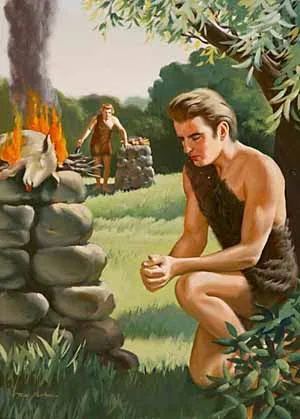
The first act of worship recorded in the Bible is the offering of Cain and Abel:
“And in process of time it came to pass, that Cain brought of the fruit of the ground an offering unto the LORD. And Abel, he also brought of the firstlings of his flock and of the fat thereof. And the LORD had respect unto Abel and to his offering.” (Genesis 4:3-4)
Notice that both brothers worshipped the same God. The difference was not between many gods but between a heart that came in faith and one that did not (Hebrews 11:4). The first division in worship was not about idols. It was about whether a person approached the one true God on His terms.
Soon after this, the Bible says people began to seek the Lord by name:
“And to Seth, to him also there was born a son; and he called his name Enos: then began men to call upon the name of the LORD.” (Genesis 4:26)
Enoch “walked with God” (Genesis 5:24), and Noah “found grace in the eyes of the LORD” (Genesis 6:8). In the earliest chapters of the Bible, the picture is one God and the people who honored Him.
How did idols begin?
According to the Bible, idolatry began not as the first religion but as a departure from the truth. Paul describes what happened:
“Because that, when they knew God, they glorified him not as God, neither were thankful; but became vain in their imaginations, and their foolish heart was darkened. Professing themselves to be wise, they became fools, And changed the glory of the uncorruptible God into an image made like to corruptible man, and to birds, and fourfooted beasts, and creeping things.” (Romans 1:21-23)
On this account, humanity knew God and then turned away. The worship of images and many gods was a later corruption, not the original religion.
The story of Babel (Genesis 11) is where the Bible shows people organizing themselves in rebellion, building a tower to “make us a name” (Genesis 11:4), and God scattering them across the earth. After that, the nations spread out and took their religions with them, and the Bible says they drifted into worshipping what God had made instead of the Maker (Romans 1:25).
Abraham leaves his father’s gods
When the Bible turns to Abraham, it describes a family that had already fallen into idol worship. Joshua tells Israel:
“Your fathers dwelt on the other side of the flood in old time, even Terah, the father of Abraham, and the father of Nachor: and they served other gods.” (Joshua 24:2)
God called Abraham out of that world (Genesis 12:1-3). In other words, the Bible says that Abraham did not invent the worship of one God. He returned to the original worship that his family had abandoned. And in Genesis 14, even before Abraham’s calling was complete, he meets Melchizedek, “priest of the most high God” (Genesis 14:18), who was already a worshipper of the true God among the nations.
The same pattern runs through the Bible: the one God is first, and idolatry is the later departure.
Is there any evidence outside the Bible?
This is where it is important to be honest. The Bible’s account of the earliest worship is a claim of faith, and archaeology cannot test it directly. Most historians of religion today place the earliest religious practices in a world of many spirits and gods, and many hold that belief in one God developed later. That is the standard academic view, and I won’t pretend it isn’t.
That said, there is an interesting history here. In the early 20th century, an anthropologist and priest named Wilhelm Schmidt gathered evidence of a widespread belief in a single high creator god among many ancient and tribal peoples, often a distant sky-god who was largely set aside in favor of lesser spirits. He argued this pointed to an original belief in one God that was later displaced. His theory was influential but is disputed, and many scholars have rejected it.
I mention it not as proof but to show that the idea of an early belief in one Creator is not something Christians invented. It’s a question people have taken seriously.
What about the Vedas?
This is a fair thing to raise. Many Hindu scholars point out that the Rigveda includes hymns that speak of a single reality behind all the gods. One well-known verse says that the wise call the One by many names. Some hymns, such as the Nasadiya Sukta, wonder aloud about whether anyone really knows how the world began.
I respect that people have looked for the One for a very long time, and the question of whether early Vedic religion was originally more monotheistic than later Hinduism is debated by scholars. But there is a difference between seeking a single reality and knowing the Creator who has revealed Himself. The Bible’s claim is that God did not leave us guessing. He spoke, He acted in history, and in Jesus He came to us.
“God, who at sundry times and in divers manners spake in time past unto the fathers by the prophets, Hath in these last days spoken unto us by his Son.” (Hebrews 1:1-2)
The question that matters most
Even if we agree to set aside the debate over which religion is older, the more important question remains: who is the God who made us, and how can we know Him?
Paul made this point to the people of Athens. They had altars to many gods, including one marked “To the unknown God.” Paul said:
“Whom therefore ye ignorantly worship, him declare I unto you. God that made the world and all things therein, seeing that he is Lord of heaven and earth, dwelleth not in temples made with hands… And hath made of one blood all nations of men for to dwell on all the face of the earth… That they should seek the Lord, if haply they might feel after him, and find him, though he be not far from every one of us.” (Acts 17:23-27)
Every nation, in every age, has been feeling after God. And the good news Paul preached is that God is not far from every one of us, and that He has made Himself known.
What Jesus offers
The first worship was a relationship, and that relationship was broken by sin. Jesus came to restore it.
“For God so loved the world, that he gave his only begotten Son, that whosoever believeth in him should not perish, but have everlasting life.” (John 3:16)
“But God commendeth his love toward us, in that, while we were yet sinners, Christ died for us.” (Romans 5:8)
In Genesis, humanity walked with God in the garden. In Revelation, the Bible ends with that same promise renewed:
“Behold, the tabernacle of God is with men, and he will dwell with them, and they shall be his people, and God himself shall be with them, and be their God.” (Revelation 21:3)
The story begins with God and His people together, and it ends with them together again. Jesus is the way back.
An invitation
You don’t have to settle the question of which religion is oldest before you come to God. The first worship was simple: a creature coming to his Creator. You can do that now.
“That if thou shalt confess with thy mouth the Lord Jesus, and shalt believe in thine heart that God hath raised him from the dead, thou shalt be saved.” (Romans 10:9)
You can pray something like this:
“Lord God, You are the Creator who made me. I admit that I have sinned and turned away from You. I believe that Jesus died for me and rose again. Forgive me, bring me back to You and be my Lord and Savior. Amen.”
If you prayed that, tell a Christian friend, find a Bible-believing church and begin reading the Gospel of John.
The first worship was one God and one people. Jesus came to bring us back to it.
Glory to Jesus Christ, the Creator and Redeemer.