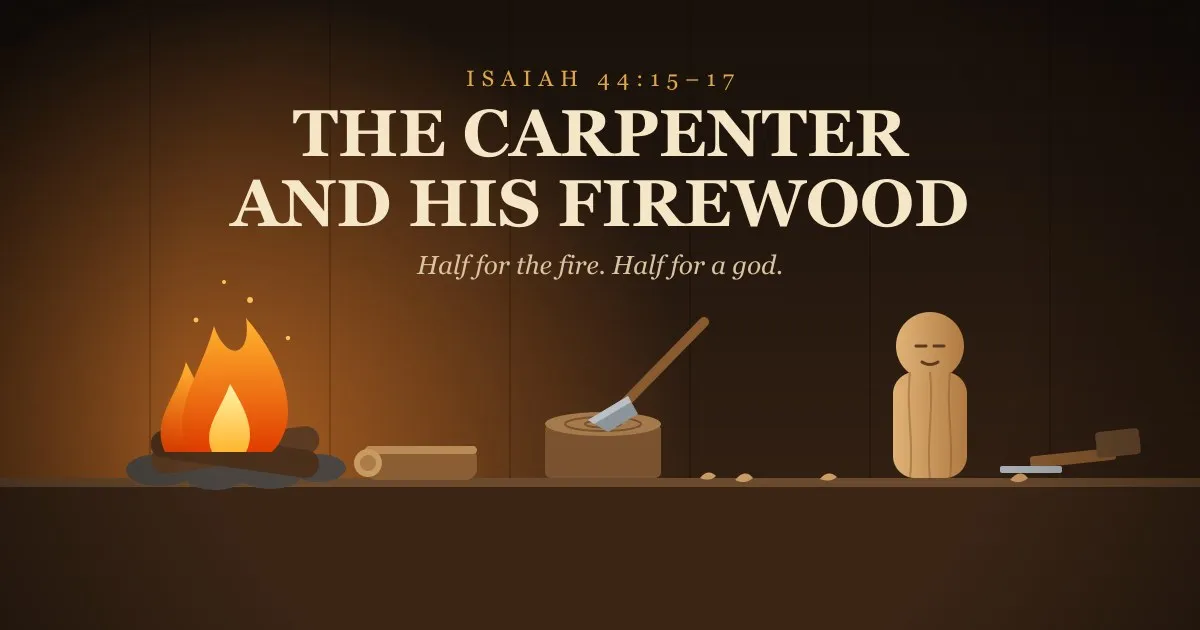
There is a passage in the Bible so vivid that you can almost smell the smoke. It describes a man at work in his workshop, and it asks a question that is hard to answer: if he made the god, in what sense is it a god?
It comes from Isaiah 44, and it is one of the sharpest arguments against idol worship ever written, delivered not with anger but with a kind of stunned disbelief.
The scene in Isaiah 44
Isaiah begins by saying that those who make idols are “all of them vanity; and their delectable things shall not profit” (Isaiah 44:9). Then he walks us through the workshop.
First comes the blacksmith and his tools:
“The smith with the tongs both worketh in the coals, and fashioneth it with hammers, and worketh it with the strength of his arms: yea, he is hungry, and his strength faileth: he drinketh no water, and is faint.” (Isaiah 44:12)
Notice the detail: the man who makes the god gets hungry, gets thirsty and grows weak. The maker needs food and water. The thing he is making will never need anything, because it never lives at all.
Then the carpenter:
“The carpenter stretcheth out his rule; he marketh it out with a line; he fitteth it with planes, and he marketh it out with the compass, and maketh it after the figure of a man, according to the beauty of a man; that it may remain in the house.” (Isaiah 44:13)
He measures, marks, planes and shapes the wood into the likeness of a person. Notice the last phrase: that it may remain in the house. Even the purpose of the statue is revealing, since it is a god that is installed where the owner decides to put it.
Where the wood comes from
Now Isaiah turns to the source of the wood:
“He heweth him down cedars, and taketh the cypress and the oak, which he strengtheneth for himself among the trees of the forest: he planteth an ash, and the rain doth nourish it.” (Isaiah 44:14)
Look at what this says. The man plants a tree. The rain feeds it. God sends the rain, God makes it grow, and then the man cuts it down and makes a god out of it. The one true God supplied the material, and the man gave the credit to the product.
Half for the fire, half for the god
Then comes the sentence that makes the whole argument:
“Then shall it be for a man to burn: for he will take thereof, and warm himself; yea, he kindleth it, and baketh bread; yea, he maketh a god, and worshippeth it; he maketh it a graven image, and falleth down thereto. He burneth part thereof in the fire; with part thereof he eateth flesh; he roasteth roast, and is satisfied: yea, he warmeth himself, and saith, Aha, I am warm, I have seen the fire: And the residue thereof he maketh a god, even his graven image: he falleth down unto it, and worshippeth it, and prayeth unto it, and saith, Deliver me; for thou art my god.” (Isaiah 44:15-17)
Read it slowly. Here is one log from one tree. A man cuts it in two. With the first half, he warms his hands, cooks his dinner and eats until he is full. With the second half, he carves a figure, falls down in front of it and says, “Deliver me; for thou art my god.”
The same wood is firewood in the morning and a god in the afternoon, and nothing about the wood has changed.
Isaiah’s question is not about the wood. It is about the man’s reasoning.
“Is there not a lie in my right hand?”
Isaiah says that the man who does this has stopped thinking:
“They have not known nor understood: for he hath shut their eyes, that they cannot see; and their hearts, that they cannot understand. And none considereth in his heart, neither is there knowledge nor understanding to say, I have burned part of it in the fire; yea, also I have baked bread upon the coals thereof; I have roasted flesh, and eaten it: and shall I make the residue thereof an abomination? shall I fall down to the stock of a tree?” (Isaiah 44:18-19)
No one stops to ask, “I burned half of this to cook my dinner. Shall I now bow down to the other half?”
Then comes the last line of the passage, which may be the most piercing:
“He feedeth on ashes: a deceived heart hath turned him aside, that he cannot deliver his soul, nor say, Is there not a lie in my right hand?” (Isaiah 44:20)
A lie in my right hand. The very hand that shaped the statue is holding the proof that it is a lie. The man cannot save himself, and the god he made cannot save him either.
Why Isaiah says this
Isaiah does not write this to mock the man. The whole chapter is a contrast. Just before the workshop scene, God says:
“I am the first, and I am the last; and beside me there is no God.” (Isaiah 44:6)
“Is there a God beside me? yea, there is no God; I know not any.” (Isaiah 44:8)
And just after, God says to His people:
“Remember these, O Jacob and Israel; for thou art my servant: I have formed thee; thou art my servant: O Israel, thou shalt not be forgotten of me. I have blotted out, as a thick cloud, thy transgressions, and, as a cloud, thy sins: return unto me; for I have redeemed thee.” (Isaiah 44:21-22)
The contrast is the heart of the matter. The idol was formed by a man, but Israel was formed by God. The carpenter makes a god who cannot save him, and the true God, who made the carpenter, says “return unto me; for I have redeemed thee.”
The same question elsewhere in Isaiah
Isaiah returns to this argument again. In chapter 46, he describes how idols are carried:
“They lavish gold out of the bag, and weigh silver in the balance, and hire a goldsmith; and he maketh it a god: they fall down, yea, they worship. They bear him upon the shoulder, they carry him, and set him in his place, and he standeth; from his place shall he not remove: yea, one shall cry unto him, yet can he not answer, nor save him out of his trouble.” (Isaiah 46:6-7)
Think about the sequence: people pay for it, they carry it, they place it, and it stays where it is put. When someone cries to it, it cannot answer.
Compare this with how the true God describes Himself a few verses earlier:
“Even to your old age I am he; and even to hoary hairs will I carry you: I have made, and I will bear; even I will carry, and will deliver you.” (Isaiah 46:4)
The idols are carried by their worshippers. The true God carries His worshippers.
“But we don’t worship the wood”
A fair-minded Hindu will respond to this, and the response deserves to be heard. Many Hindus say they do not worship the stone or the metal. They say the image, the murti, is a focus for devotion, like a photograph of someone you love or a flag you honor. In many traditions, a ceremony is performed in which the deity is invited to dwell in the image, and the image is treated with reverence because it is the deity’s presence. Others say the image is a symbol that helps the mind focus on the formless Brahman.
That is an honest explanation, and I don’t want to caricature it. Here is how the Bible responds.
First, the Bible forbids it even for that reason. The second commandment does not say, “Do not worship images as if they were God.” It says:
“Thou shalt not make unto thee any graven image, or any likeness of any thing that is in heaven above, or that is in the earth beneath, or that is in the water under the earth: Thou shalt not bow down thyself to them, nor serve them.” (Exodus 20:4-5)
Images made to represent the true God were not allowed either. Remember Aaron’s golden calf, which he said was “a feast to the LORD” (Exodus 32:5). God was not pleased with that.
Second, Isaiah’s question still stands. If a deity must be invited into an image made by human hands, placed where the owner chooses, bathed, dressed and fed, then the human being is the one in charge. The true God is not summoned by a ceremony. He is the one who made the priest.
Third, Paul addressed this directly when he spoke to the Athenians:
“Forasmuch then as we are the offspring of God, we ought not to think that the Godhead is like unto gold, or silver, or stone, graven by art and man’s device.” (Acts 17:29)
If we are God’s offspring, living, thinking and breathing, then it makes no sense to imagine that He is like a block of metal or stone.
What this means for you
You may never have burned a log and then bowed to the rest. But Isaiah’s question is for everyone who has put their trust in something that was made, whether it is a statue, a ritual, money, success or a person. Ask honestly:
- Can it hear me?
- Can it answer me?
- Can it save me when I am in trouble?
- Who made it?
If the honest answers are no, no, no and “someone like me,” then Isaiah’s conclusion follows. You are holding a lie in your right hand.
The God who made the tree
The wonderful thing is that the God Isaiah describes is not far from us. The same God who made the tree and sent the rain speaks, and He says:
“Look unto me, and be ye saved, all the ends of the earth: for I am God, and there is none else.” (Isaiah 45:22)
He is not an object to be carried but a Savior who carries. And He proved it by coming to us in Jesus Christ.
“But God commendeth his love toward us, in that, while we were yet sinners, Christ died for us.” (Romans 5:8)
“For God so loved the world, that he gave his only begotten Son, that whosoever believeth in him should not perish, but have everlasting life.” (John 3:16)
The carpenter shapes a god out of wood, and the true God let wood be shaped into a cross, and died on it for the carpenter. That is how different He is.
An invitation
Isaiah’s call is the same today as it was then: “return unto me; for I have redeemed thee.” If you have been bowing to something made by human hands, you can turn to the God who made your hands.
“Ye turned to God from idols to serve the living and true God.” (1 Thessalonians 1:9)
“That if thou shalt confess with thy mouth the Lord Jesus, and shalt believe in thine heart that God hath raised him from the dead, thou shalt be saved.” (Romans 10:9)
You can pray something like this:
“Lord Jesus, I turn away from everything made by human hands that I have trusted in. I admit that I have sinned and cannot save myself. I believe You died for me and rose again. Forgive me, come into my life and be my Lord and Savior. Amen.”
If you prayed that, tell a Christian friend, find a Bible-believing church and begin reading the Gospel of John.
The idol is made by the carpenter. The living God made the carpenter, and He came to save him.
Glory to Jesus Christ, the one true and living God.